

Grid capacity is rapidly emerging as one of the biggest constraints on the future of artificial intelligence. Every major advance in AI seems to arrive faster than the last, but behind every breakthrough lies something far less glamorous: the electricity required to power the massive computing systems that make increasingly advanced AI possible.
As AI models become larger and more capable, the race to build them is beginning to expose a different kind of bottleneck. It isn’t software. It isn’t microchips. It’s the electric grid’s ability to generate and deliver enough power to meet AI’s rapidly expanding demand for computing.
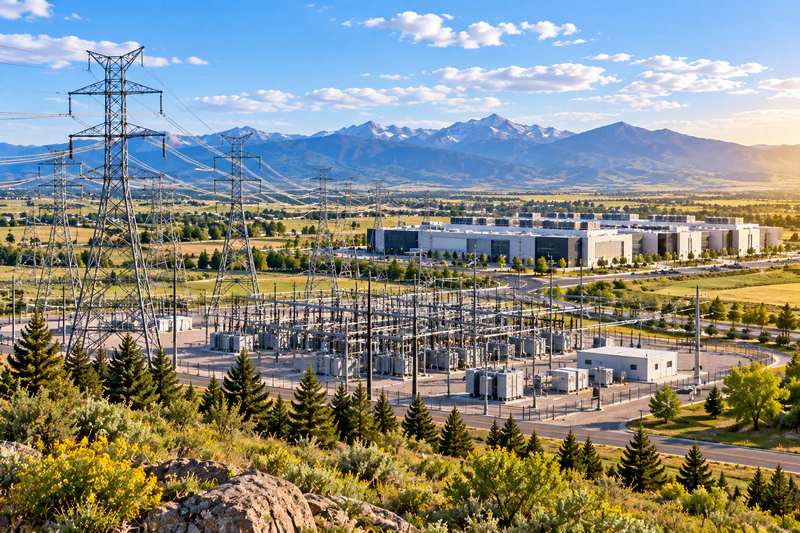
The result is a growing grid capacity crunch: a widening gap between the computing power AI demands and the electricity infrastructure available to support it.
For all the excitement surrounding new AI models, the real bottleneck may not be smarter algorithms, but the electricity needed to run them.
We’re not talking about today’s chatbots such as Claude and ChatGPT, impressive as they are. We’re talking about the next generation of AI systems designed to solve complex problems, carry out long sequences of tasks, and make increasingly sophisticated decisions. Those systems require vastly more computing power, and every additional computation requires electricity.
Unlike a chatbot that produces an answer in a single pass, advanced AI systems often work through problems step by step. They may explore multiple solutions, check their own work, call on specialized AI tools, and revise their answers before producing a final response.
Every additional step requires more computation. More computation increases AI’s electricity demand.
That is why advanced AI planning systems can require anywhere from ten to a thousand times more computation than a simple chatbot, depending on the task. As AI systems become more capable, their appetite for electricity grows just as quickly.
The Mach 2 race car with no road
Imagine a race car designed to reach Mach 2—twice the speed of sound. For the numbers nerds, that’s roughly 1,534 miles per hour.
On paper, the car is a marvel of engineering. But there’s no road capable of handling it and almost no fuel available to keep it running.
That increasingly resembles AI’s power challenge.
The technology is advancing at breathtaking speed. Researchers continue to develop larger models, faster chips, and more capable software. But the power infrastructure beneath those advances is expanding much more slowly.
Eventually, the limitation is no longer the car.
It’s the road.
Former Google CEO Eric Schmidt recently told the U.S. House Energy & Commerce Committee that the United States alone may need an additional 90 gigawatts of generating capacity to support the next wave of AI development. That’s roughly equivalent to the output of dozens of nuclear power plants.
Elon Musk has been equally direct. He has argued that the fundamental limitation on AI’s future will be electricity generation. And Arm CEO Rene Haas, whose company designs the processors used in most of the world’s smartphones and is expanding into energy-efficient chips for AI data centers, has called AI’s energy appetite “insatiable.” He has warned that, if current trends continue, AI-related data centers could consume more than 20% of U.S. electricity by the end of the decade.
Schmidt, Musk, and Haas come from different parts of the technology world, yet all point to the same conclusion: as AI grows more capable, demand for electricity is becoming one of the industry’s defining challenges.
Why grid capacity matters
The reasons are becoming increasingly visible.
A single campus-scale AI data center can consume as much electricity as a mid-sized city. Multiply that by dozens—or eventually hundreds—of facilities around the world, and the electric grid begins to look less like background infrastructure and more like a strategic asset.
The consequences extend well beyond technology companies. Building enough electricity for AI means making decisions about new power plants, transmission lines, land use, water supplies for cooling, and energy costs that will affect entire communities.
This isn’t simply an engineering problem. It’s also a question of national strategy.
If electricity becomes the limiting factor for increasingly advanced AI systems, countries with abundant, affordable, and reliable power gain a significant competitive advantage alongside those with the best chips, software, and researchers.
Canada’s vast hydroelectric resources, the Gulf states’ willingness to invest heavily in new generating capacity, and China’s aggressive expansion of its electric grid all illustrate how energy policy is becoming AI policy.
For the United States, Schmidt’s estimate of an additional 90 gigawatts of generating capacity underscores the scale of the challenge. Expanding the electric grid takes years, often decades. AI development is moving much faster.
That growing mismatch is what we call the grid capacity crunch.
AI is often discussed as though its growth is inevitable—as if the only questions are how quickly models improve and what they will eventually be able to do.
The physical infrastructure tells a different story.
Computing capacity continues to grow at extraordinary speed. Electrical infrastructure does not.
Eventually, ambition meets amperage.
This widening gap between AI’s demand for computing and the grid’s ability to supply electricity defines the grid capacity crunch.
Where the road leads
AI’s growing demand for electricity is the headline. The meat of the story is that every breakthrough ultimately depends on power plants, transmission lines, substations, and the infrastructure that delivers electricity where it’s needed.
So where does that leave us?
Happening now
Technology companies are already placing large data center campuses near abundant, low-cost sources of electricity. Utilities are upgrading transmission where excess capacity exists. Chip designers are squeezing more performance from every watt, while engineers develop better cooling systems to reduce energy waste.
These improvements help, but they don’t fundamentally change the trajectory. As AI becomes more capable, demand for computing power continues to grow even faster.
Through 2030
The next several years are likely to become the center of gravity for AI infrastructure investment.
Major cloud providers and electric utilities are funding new natural gas plants, expanding renewable generation where practical, building larger substations, and constructing multi-billion-dollar AI campuses designed around reliable access to electricity.
The effort extends well beyond the United States.
India has announced plans to add roughly 10 gigawatts of grid capacity to support AI infrastructure. Several Gulf states are investing in new generating capacity measured in multiple gigawatts as they compete to become regional AI hubs.
These projects are no longer theoretical. Many are already underway.
After 2030
The largest improvements will take the longest to build.
New transmission corridors, major generating facilities, expanded regional power markets, and other large infrastructure projects can significantly increase grid capacity—but only after years of planning, permitting, financing, and construction.
On paper, proposals to dramatically expand electrical capacity can appear straightforward.
In reality, every new transmission line, power plant, and substation must navigate environmental reviews, permitting requirements, financing, material shortages, and construction schedules.
The grid can grow, yes. But it cannot grow overnight.
Probably never
One idea appears unlikely to survive contact with reality: that AI can continue scaling indefinitely without a corresponding increase in electricity.
Better algorithms and more efficient chips absolutely matter. They make every watt more productive.
History, however, suggests that greater efficiency rarely reduces total demand. Instead, it enables even more ambitious applications.
The reward for doing more with less is usually finding new ways to do even more. For AI, that means more computation—and ultimately more electricity.
The bottom line
AI often feels limitless. However, its physical infrastructure is not.
The next generation of AI will be measured not only by larger models, smarter software, or more powerful chips, but also by the ability to generate and deliver the electricity those systems require.
That’s the paradox.
Intelligence that appears almost limitless remains tethered to one of the most tangible limits of all: available power.
The Mach 2 race car is being built.
The question is whether we can build enough road—and produce enough fuel—to let it run.
FAQs
Q1: Why is AI using so much more electricity?
Today’s most advanced AI systems increasingly solve problems by performing many more computations than traditional chatbots. They evaluate alternatives, check their own work, and use specialized AI tools, all of which require additional computing—and additional electricity.
Q2: What is the grid capacity crunch?
The grid capacity crunch is the growing gap between AI’s rapidly increasing demand for computing power and the electric grid’s ability to generate and deliver enough electricity to support it.
Q3: Can’t better chips solve the problem?
More efficient microchips help reduce the amount of electricity needed for each computation. But as AI systems become more capable, they also perform many more computations, so overall electricity demand continues to rise.
Q4: Why does this matter beyond the technology industry?
Meeting AI’s growing electricity needs will require major investments in power generation, transmission lines, substations, and other infrastructure. Those decisions will influence energy costs, land use including environmental impact, economic development, and national competitiveness for years to come.