

Science doesn’t move this fast. At least it didn’t until AlphaFold arrived.
For more than fifty years, biologists wrestled with a stubborn question: given a protein’s amino-acid sequence, can the three-dimensional shape it takes inside a cell be predicted?
Why does this matter?
Because the shape of a protein largely determines what it does—how it binds to other molecules, how it moves, and where a drug might fit. Understanding protein structure helps scientists design more precise treatments with fewer side effects.
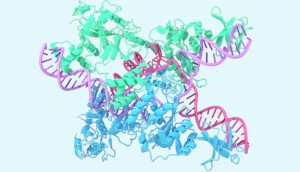
AlphaFold solved that staggeringly difficult puzzle.
Two hundred million times.
In about a year.
Launched in July 2021, Google DeepMind’s AlphaFold had, by August 2022, predicted the 3D structures of roughly 200 million known proteins. DeepMind CEO Demis Hassabis described the achievement as representing “a billion years of PhD time.”
The estimate comes from a common rule of thumb in biology: determining a single protein structure experimentally can take a PhD student four to five years. Scaled across approximately 200 million proteins, that amounts to roughly a billion PhD-years of work.
What is AlphaFold?
AlphaFold is an artificial intelligence system developed by Google DeepMind that predicts a protein’s three-dimensional structure directly from its amino-acid sequence.
Trained on decades of experimental data, the system produces highly accurate models, often within the width of an atom.
The breakthrough reached its full potential when DeepMind partnered with the European Bioinformatics Institute to release a free database containing roughly 200 million predicted protein structures. Researchers around the world could immediately access and use the results.
A decades-long scientific bottleneck suddenly became a starting point for discovery.
From epic breakthrough to everyday practice
Accuracy is what makes this advance meaningful for working scientists.
Predictions that are accurate to roughly an atom’s width are often precise enough to guide experiments. Researchers can use them to design modified proteins, estimate where molecules may bind, and identify the most promising hypotheses to test.
Instead of starting from scratch, experiments can begin much farther down the road.
The open database matters just as much as the breakthrough itself. By placing millions of protein structures in one searchable resource, AlphaFold democratized access to knowledge that once required years of specialized effort.
With a clear research question and access to the database, even a small team can get to work quickly.
What changed when the database went live?
When a once-intractable research challenge becomes a matter of looking up a protein structure, researchers can spend their time differently.
The question shifts from:
“Can we determine this structure?”
to:
“What does this structure allow us to try?”
That change accelerates the pace of discovery.
AlphaFold also points to a broader pattern in AI. Systems that learn from experience, guided by clear goals and rapid feedback, can uncover patterns that would have taken humans years—or even decades—to identify through traditional methods.
And that’s where the story reconnects with AlphaGo.
The same approach that produced Move 37—a move that stunned the world’s best Go players—also unlocked one of biology’s greatest puzzles.
From AlphaGo to AlphaFold, the pattern is the same: AI discovers hidden possibilities that humans had overlooked.
In the case of AlphaFold, those discoveries arrived at warp speed, transforming a decades-long bottleneck into rocket fuel for biological research.
FAQs
Q1. What is AlphaFold in simple terms?
AlphaFold is an AI system that predicts a protein’s 3D shape from its amino-acid sequence quickly and accurately enough to guide scientific research.
Q2. How accurate are AlphaFold’s predictions?
Many predictions are accurate to roughly the width of an atom, making them useful for planning experiments and generating scientific hypotheses.
Q3. Why does the AlphaFold database matter?
It places approximately 200 million predicted protein structures into a searchable resource that researchers around the world can access and use.
Q4. Can AlphaFold replace laboratory experiments?
No. AlphaFold helps narrow possibilities and generate hypotheses, but experimental testing is still required to confirm results.