

You step onto a wide access road and look across a sprawling industrial campus. Instead of one building, you see several long, windowless structures arranged in rows like aircraft hangars. Each is fed by massive electrical lines running both above and below ground.
Off to the side stand transformers taller than a two-story house, lined up in armored ranks. Beyond them rises a substation built specifically for the campus, its lattice of steel and humming transmission lines drawing steady power from the regional electrical grid.
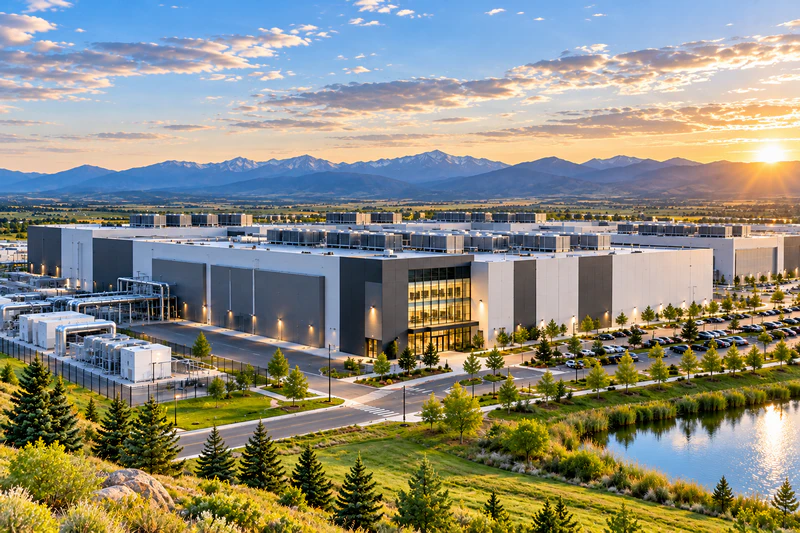
This is what a modern AI megacluster looks like: not one building, but a campus of three, five, or even eight interconnected structures. Inside, the buildings feel dense and intensely engineered. Every server rack—a tall metal cabinet that holds stacks of computers and networking equipment—draws enormous amounts of power, and every aisle is designed for advanced liquid cooling. The heat generated by thousands of AI accelerators is so intense that many facilities rely on industrial-scale chillers and, in some cases, immersion cooling systems instead of traditional air cooling.
Redundant power feeds run throughout the campus. Multiple layers of physical security—including controlled access points, surveillance systems, reinforced perimeter fencing, and hardened infrastructure—help protect the facility against severe weather, cyberattacks, and potential acts of sabotage.
At first glance, this might look like an ordinary data center—the kind of facility that stores websites, streams movies, backs up photos, and powers cloud computing. But it is built for something very different.
The United States is home to thousands of conventional data centers that support the digital services we use every day. By comparison, only a relatively small number of campuses have been purpose-built as AI megaclusters. Rather than handling millions of separate online tasks, these facilities are designed for one extraordinarily demanding job: training the world’s largest artificial intelligence models.
That mission changes almost everything. AI megaclusters require far more electricity, cooling, networking, and physical space than traditional data centers. As AI models continue to grow, those demands are reshaping how the next generation of digital infrastructure is designed and where it can be built.
Where entire buildings work as one machine
From the outside, the campus resembles a hybrid of data center and power plant. Inside, it behaves like one enormous machine, with multiple buildings operating as a single computing system capable of running AI training jobs that may continue for weeks without interruption.
The “mega” refers to the campus itself. The “cluster” describes the way every building is connected by high-speed fiber, electrical infrastructure, and tightly coordinated computing systems.
Together, these features define a new generation of AI campuses built around enormous computing power and equally enormous energy demands. Their machines are designed to work together as a unified system. To understand why these facilities are changing the landscape of AI, it helps to look inside.
A new class of facility built around AI accelerators
Step inside one of these buildings and its purpose becomes immediately clear. Room after room is packed with specialized hardware built for one primary task: training large AI models at massive scale.
At the center of this hardware are AI accelerators—specialized chips designed to perform the complex mathematical operations behind modern artificial intelligence. They can process millions of calculations simultaneously, making them dramatically faster and more efficient than traditional computer processors for AI workloads.
Because of that capability, AI megaclusters are built for a very different purpose than conventional data centers: training extremely large AI models that require enormous amounts of computing power operating continuously for extended periods.
Instead of a handful of server racks filled with AI accelerators, today’s largest AI campuses may contain tens of thousands of accelerators arranged in dense, repeating rows.
Those rows sit shoulder to shoulder, each drawing far more electricity than a traditional server row while producing equally extraordinary amounts of heat. Sophisticated cooling systems remove that heat fast enough to keep long training runs stable and uninterrupted. A training run is the extended process through which an AI system learns from vast amounts of data, often continuing around the clock for days or even weeks.
As AI models continue to grow in size and complexity, many companies are designing these facilities to support increasingly demanding workloads while balancing power, cooling, and reliability. That trend is reshaping not only what data centers look like, but also where and how they are built.
How thousands of machines work as one
A conventional cloud data center may be serving millions of unrelated requests at the same time—streaming a movie, storing family photos, processing a bank transaction, or running a business application. An AI megacluster works very differently.
Every part of it—the AI accelerators, cooling systems, network switches, and power infrastructure—must work together as one coordinated system. A single interruption can ripple across the entire operation, which is why these facilities are engineered for exceptional reliability.
The way these machines connect shapes the entire campus. AI accelerators constantly exchange enormous amounts of information while training a model. The farther apart they are, the longer those exchanges take. Keeping them physically close helps the entire system learn faster and operate more efficiently.
Eventually, a single building reaches practical limits for power, cooling, and networking. Rather than making one building ever larger, companies expand into neighboring buildings that remain tightly connected by high-speed fiber and electrical infrastructure. That’s why AI megaclusters spread across sprawling campuses rather than rising into skyscrapers.
Why these facilities keep getting bigger
Each new generation of AI models requires more computing power than the one before it. Supporting that growth means adding more AI accelerators, delivering more electricity, and removing more heat. As those requirements increase, so does the size of the facilities built to house them.
Ultimately, the design of an AI megacluster is governed less by architectural preference than by physics. Electricity, cooling, and the speed at which machines communicate place practical limits on every building. Rather than growing upward, these campuses expand outward as AI’s infrastructure needs continue to increase.
Where future megaclusters will be built
The next generation of AI megaclusters will be built in places that can guarantee something increasingly valuable: large, reliable supplies of electricity available around the clock. That single requirement is likely to play a major role in determining where future AI infrastructure can be built.
In the past, data centers were often located near technology hubs and major fiber-optic networks. Today, power availability has become the first consideration. Companies increasingly look for sites near existing power plants or places where new generating capacity can be added relatively quickly. Land matters too—not only for the buildings themselves, but also for the substations, cooling systems, and high-voltage transmission lines that support them. Regions that can streamline permitting for those upgrades gain a significant advantage.
Some of America’s traditional data-center hubs are approaching practical limits on available land and electrical capacity. As a result, companies are increasingly looking toward regions that can provide abundant power, room to expand, and faster permitting for new electrical infrastructure.
In the years ahead, access to reliable electricity may become just as important as access to fiber-optic networks once was. As AI continues to grow, the map of digital infrastructure is likely to be shaped as much by the availability of power as by the availability of computing technology.
What will power AI megaclusters?
Even today, the largest AI megaclusters consume as much electricity as small towns. As AI models grow larger and more capable, newer AI megaclusters are being designed to support even greater electrical demands. Meeting that demand has become one of the biggest challenges facing the expansion of AI infrastructure. [Internal link: AI’s Power Thirst]
What matters most to an AI megacluster is not a particular energy source, but a dependable supply of electricity delivered around the clock. Utilities, technology companies, and policymakers are exploring multiple ways to meet that need, with solutions that will vary by region depending on available resources, economics, and existing infrastructure.
Meeting the enormous electrical demands of AI megaclusters will require a combination of energy sources that differs from one region to another. Each approach comes with its own advantages, costs, and engineering challenges. Whatever the mix, one requirement remains constant: AI megaclusters need large amounts of reliable electricity every hour of every day.
Those demands have renewed interest in expanding electrical generating capacity. Projects under discussion include natural gas, nuclear power, renewable energy, and other emerging technologies. Which approaches ultimately prove most practical will depend on local conditions, economics, technological progress, and public policy.
One thing is already clear: AI’s growing demand for electricity is reshaping long-term planning for power generation and electrical transmission. It is also raising broader questions about infrastructure investment, land use, environmental impacts, permitting, and how communities choose to balance AI’s growing appetite for electricity with other public priorities.
Those questions reach far beyond AI megaclusters themselves. They are becoming part of a much larger conversation about how societies will build and power the infrastructure needed for the AI era.
Inside the next generation of AI megaclusters
Step inside a next-generation AI megacluster and the first thing you notice is that it feels more like an industrial facility than a traditional computer room. Liquid cooling is everywhere—in pipes, pumps, and heat exchangers that move coolant directly across the AI accelerators. In some of the highest-density computing systems, immersion cooling places entire servers into specially designed cooling fluids to remove heat even more efficiently.
Power equipment occupies far more space than in conventional data centers. Electrical rooms grow larger to accommodate heavier switchgear, transformers, and thicker cabling. Cooling plants expand to handle the enormous heat produced by thousands of AI accelerators operating simultaneously. Even fire protection and other safety systems must evolve to accommodate the higher power densities of these facilities.
Building an AI megacluster is only part of the story. As more of these campuses are constructed, they will increasingly influence the communities, economies, and electrical grids that surround them.
What this means for communities and regions
The impact of AI megaclusters extends far beyond the boundaries of the campus itself. When one is built, it brings construction jobs, long-term operations positions, and significant tax revenue. Utilities often upgrade substations and expand transmission infrastructure to support the project, investments that can benefit surrounding communities as well. For many regions, AI megaclusters represent substantial economic opportunities.
These projects also bring challenges. Large campuses require extensive land, new substations, and additional transmission infrastructure. In some locations, cooling systems may increase demand for water. Residents and local officials must weigh those needs alongside questions about permitting, environmental impacts, and whether existing electrical systems can support continued expansion.
At the national level, the picture becomes even larger. Meeting AI’s growing demand for electricity will require continued investment in generating capacity, transmission infrastructure, and coordination among utilities, regulators, and policymakers. Decisions about where AI megaclusters are built and how they are powered are becoming part of broader discussions about economic development, energy policy, and the future of critical infrastructure.
The impact of AI megaclusters extends far beyond the boundaries of the campus itself. When one is built, it brings construction jobs, long-term operations positions, and significant tax revenue. Utilities often upgrade substations and expand transmission infrastructure to support the project, investments that can benefit surrounding communities as well. For many regions, AI megaclusters represent substantial economic opportunities.
These projects also bring challenges. Large campuses require extensive land, new substations, and additional transmission infrastructure. In some locations, cooling systems may increase demand for water. Residents and local officials must weigh those needs alongside questions about permitting, environmental impacts, and whether existing electrical systems can support continued expansion.
At the national level, the picture becomes even larger. Meeting AI’s growing demand for electricity will require continued investment in generating capacity, transmission infrastructure, and coordination among utilities, regulators, and policymakers. Decisions about where AI megaclusters are built and how they are powered are becoming part of broader discussions about economic development, energy policy, and the future of critical infrastructure.
The infrastructure behind the AI age
For decades, advances in computing were driven largely by faster chips and better software. AI is adding a new requirement: an entirely new generation of physical infrastructure.
AI megaclusters bring together enormous computing power, electrical systems, cooling technology, and networking on a scale rarely seen outside major industrial projects. Their success will depend not only on advances in artificial intelligence, but also on the engineers, utilities, builders, and communities that make those advances possible.
The next breakthroughs in AI will not emerge from algorithms alone. They will also depend on the power plants, transmission lines, cooling systems, and AI megaclusters that increasingly form the physical foundation of the AI age. Understanding artificial intelligence now means understanding the infrastructure that makes it possible.